
Table of Contents
A Guide to Immersive Technology Solutions for Enterprise
As digital transformation accelerates, immersive technology solutions are becoming essential tools for forward-thinking organisations. Your enterprise can leverage these systems, which include augmented reality (AR), virtual reality (VR), mixed reality (MR), and the broader category of extended reality (XR), to unlock new levels of efficiency and engagement. The XR Association, the leading industry body, provides a framework for understanding and adopting these technologies responsibly, ensuring they are deployed to power business outcomes safely and effectively.
You are likely exploring these tools for several strategic reasons: to enhance training with realistic simulations, to accelerate design and prototyping cycles, or to reduce operational costs through remote collaboration. For instance, industrial AR solutions in Australia are now being deployed in the mining and manufacturing sectors to provide hands-free guidance to field workers, overlaying critical data directly onto their work environment. This allows your team to perform complex maintenance or assembly tasks with greater accuracy and safety.
Across the country, enterprises in healthcare, resources, and construction are integrating immersive technologies to solve real-world problems. By adopting these solutions, your organisation can improve knowledge retention, connect distributed teams, and create compelling customer experiences that differentiate your brand. The next section will delve into specific implementation strategies, building on this foundational understanding of how AR and VR can be practically applied in your business.
Unity Real-Time Development Platform
The Unity Real-Time Development Platform stands as a key enabler for building sophisticated immersive technology solutions across multiple sectors. It provides a robust foundation for creating interactive 2D and 3D experiences, moving beyond traditional game development into enterprise, manufacturing, and education. Developers leverage its flexible engine to craft everything from detailed mobile applications to sprawling virtual worlds.
A core strength of the platform is its extensive cross-platform deployment capability. You can author a project once and deploy it across more than 20 platforms, including iOS, Android, Windows, and leading AR and VR headsets. This versatility is supported by a vast ecosystem; the Unity Asset Store and an active global community supply pre-built assets and documentation, significantly accelerating development timelines for complex projects.
For industrial applications, the engine is particularly effective in industrial AR solutions, such as interactive training simulations and guided remote assistance. These applications help reduce operational errors and improve workforce safety by providing hands-on practice without real-world risk. The platform also facilitates powerful digital twin integration by enabling real-time data visualisation and IoT connectivity, allowing managers to monitor physical assets, simulate scenarios, and make data-driven decisions from an interactive 3D dashboard. This capability creates a direct link between physical operations and responsive, interactive digital twins.
This technological foundation scales effectively from independent projects to enterprise-grade immersive experiences. By providing the tools for both creative prototyping and robust, large-scale deployment, it supports a complete development lifecycle for serious business solutions.
Unreal Engine for Enterprise
Unreal Engine has become a key platform for enterprises pursuing advanced immersive technology solutions. Originally developed for games, its real-time 3D capabilities now drive industrial-scale simulation, visualization, and training. In Australia and globally, engineering teams use the engine to prototype complex machinery, test factory layouts, and train personnel without physical risk -- transforming how products are designed and brought to market.
Enterprises leverage Unreal Engine to power industrial AR solutions such as remote assistance applications and interactive maintenance guides. By overlaying step-by-step instructions onto equipment via tablets or smart glasses, technicians reduce service time and error rates. The same framework underpins digital-twin initiatives: a digital twin integration combines live IoT data with high-fidelity 3D replicas of physical assets, enabling operators to monitor performance, simulate "what-if" scenarios, and foresee failures before they occur. These industrial AR solutions form part of a growing suite of immersive technology solutions that blend virtual and physical worlds for measurable operational outcomes.
Beyond AR and virtual replicas, real-time visualization accelerates prototyping cycles and supports collaborative design reviews across distributed teams. Organizations report lower downtime, improved safety compliance, and substantial cost avoidance from early digital validation. By embracing enterprise AR and 3D simulation, businesses in manufacturing, energy, and architecture -- as adopted by leading Australian manufacturers -- gain a competitive edge through faster, safer decision-making. This pragmatic application of real-time tools signals a shift from experimental pilots to production-grade infrastructure, paving the way for deeper digital transformation in the sections that follow.
Microsoft Mesh
As organisations seek more meaningful ways to connect distributed teams, Microsoft Mesh stands out among immersive technology solutions that are reshaping digital collaboration. This mixed-reality platform enables shared holographic experiences, allowing you to interact with colleagues in three-dimensional spaces regardless of their physical location anywhere in the world.
Built on Azure cloud infrastructure, Mesh integrates natively with Microsoft Teams and Dynamics 365, bringing immersive collaboration directly into established enterprise workflows. You can join Mesh experiences from HoloLens, VR headsets, mobile devices, or a standard PC, making spatial computing accessible without requiring specialised hardware investments. The platform supports spatial awareness and presence, giving distributed participants a genuine sense of being together in the same room.
Key capabilities of Microsoft Mesh include:
- Cross-device accessibility across HoloLens, Meta Quest, PC, and mobile platforms
- Spatial anchoring for persistent digital content placed in physical locations
- Customisable avatars with real-time gesture and expression tracking
- Microsoft 365 integration enabling collaborative workflows within immersive spaces
For Australian organisations exploring digital twin integration, Mesh provides a robust foundation for creating persistent 3D replicas of real-world environments. Teams can conduct design reviews, perform remote inspections, and run training simulations within these spatial contexts. This capability directly supports industrial AR solutions by overlaying contextual data onto physical equipment, helping technicians and engineers make informed decisions without travelling to site.
As spatial computing adoption grows across manufacturing, education, and professional services, understanding how platforms like Mesh fit into a broader strategy becomes essential. The applications that follow explore this in greater depth.
NVIDIA Omniverse
For organisations pursuing advanced immersive technology solutions, NVIDIA Omniverse provides a scalable, real-time 3D simulation and collaboration platform designed for building and operating virtual worlds. Built on Pixar's Universal Scene Description (USD) framework, it serves as a foundational layer for creating industrial digital twins, augmented-reality environments, and complex simulations that connect engineering teams globally.
The platform's architecture rests on three integrated components:
- Nucleus -- the central data management and collaboration engine that enables multi-user access, editing, and real-time synchronisation of 3D assets from any location.
- Kit -- a modular development framework for building custom applications, extensions, and microservices tailored to specific industry workflows.
- RTX renderer -- delivers physically accurate ray-tracing and path-tracing visualisation essential for design review and simulation validation.
For enterprises adopting digital twin integration, Omniverse connects with existing engineering tools -- including applications from Autodesk, Siemens, and Bentley Systems -- through USD and Material Definition Language (MDL) standards. This interoperability ensures live CAD data flows directly into simulation environments without costly format conversions, maintaining data fidelity throughout the workflow.
The platform also powers industrial AR solutions by synchronising live engineering data with augmented-reality overlays, giving factory-floor technicians real-time access to assembly instructions, maintenance procedures, and performance metrics. AI and machine learning workflows further enhance simulation accuracy by generating synthetic training data and automating scenario testing at scales impractical for manual methods.
Multi-user collaboration across distributed teams accelerates design and review cycles significantly. At MetaverseDeveloper, we help enterprises leverage Omniverse for custom digital twin development and industrial AR deployment, bridging the gap between platform capabilities and practical business outcomes.
PTC Vuforia
PTC Vuforia stands at the forefront of immersive technology solutions for industrial environments, empowering you to create and deploy augmented reality experiences that transform how work gets done. As a key enabler of industrial AR solutions, the Vuforia platform bridges the physical and digital worlds with tools that are accessible to developers and frontline workers alike.
The core of the ecosystem is Vuforia Engine, a robust developer SDK that provides advanced computer vision capabilities. Spatial mapping, image and object recognition, and model target technology allow you to accurately overlay digital information onto real-world equipment. You can build applications that run across smartphones, tablets, and a range of AR headsets, ensuring flexibility across different use cases.
For those who need to author experiences without writing code, Vuforia Studio offers a drag-and-drop environment that connects 3D models to live IoT data. When combined with Vuforia Chalk, you can provide remote assistance that lets experts annotate a technician's view in real time, speeding up troubleshooting and maintenance support.
Key features of the Vuforia platform include:
- Advanced image and object recognition for accurate equipment identification
- Area targets and spatial mapping for large-scale facility overlays
- Model targets that recognise complex 3D shapes without markers
- Cross-platform support for iOS, Android, and Microsoft HoloLens devices
- Cloud-based recognition services for scalable deployments
A defining strength of the platform is its digital twin integration. Vuforia connects seamlessly with PTC's ThingWorx and other IoT platforms, enabling you to overlay real-time operational data onto physical assets. This combination turns a static maintenance procedure into a dynamic, data-rich experience that can improve workflow efficiency and support better decision-making on the factory floor.
Common applications you can pursue with these industrial AR solutions include step-by-step assembly instructions, guided maintenance procedures, quality inspection checklists, and interactive operator training. Each scenario uses the same underlying technology to deliver the right information at the right moment, reducing errors and building workforce confidence.
By grounding immersive technology in practical, data-connected tools, PTC Vuforia shows how augmented reality evolves from a novelty into a production-ready capability. The next logical step is to examine how these experiences are deployed in real-world settings and how they measure up against broader metaverse development objectives.
Siemens Xcelerator
Siemens Xcelerator is an open digital business platform that delivers powerful immersive technology solutions by combining modular hardware, software, and digital services into a single ecosystem. Designed to accelerate digital transformation, it gives enterprises access to a curated portfolio of IoT-enabled devices, edge computing resources, and cloud-based applications that work together seamlessly. Through this integrated approach, organisations can prototype, test, and scale new capabilities faster than traditional siloed deployments allow. The platform's open architecture also supports third-party innovations, ensuring businesses are not locked into a single vendor stack as they evolve.
Two capabilities that define Xcelerator's immersive potential are industrial AR solutions and digital twin integration. Digital twins create high-fidelity virtual replicas of physical assets, machines, and entire production lines, fed continuously by real-time sensor data. When these live models are combined with industrial AR solutions, field technicians wearing headsets or using tablets can view contextual overlays--temperature readouts, maintenance histories, step-by-step repair instructions--directly on the equipment they are servicing. This fusion of data and visualisation reduces guesswork, shortens downtime, and helps teams make informed decisions on the spot. For Australian manufacturers and energy operators adopting these immersive technology solutions, the ability to blend simulation with on-site reality addresses persistent skills-gap and remote-support challenges.
Xcelerator is already supporting industries in Australia that need scalable, modular digital tools without rebuilding their entire technology foundation. By linking digital twin integration with practical industrial AR solutions, the platform lets engineering, field-service, and operations teams collaborate around a shared, up-to-date picture of every asset. While no platform can guarantee specific financial outcomes, Xcelerator's catalog-based, pay-as-you-grow model allows companies to experiment with immersive capabilities, learn from real-world data, and expand usage in line with operational needs.
Bentley iTwin Platform
The Bentley iTwin Platform is a digital twin platform that powers immersive technology solutions for infrastructure projects, providing a single pane of glass for designing, building, and operating physical assets. It goes beyond static BIM models by creating a dynamic, real-time digital replica that connects engineering data, reality capture, and IoT sensors, enabling you to make informed decisions throughout the entire lifecycle. This foundation supports immersive technology solutions such as augmented and virtual reality, which help stakeholders visualise complex structures in context. The platform ingests data from a variety of sources--including CAD, BIM, and GIS--to create a comprehensive digital twin that mirrors the physical asset in real time.
Key capabilities of the iTwin Platform include reality capture for accurate as-built conditions, 4D simulation that links project schedules with 3D models for sequencing, and cloud-based collaboration tools that allow distributed teams to interact with the digital twin simultaneously. These features directly enable industrial AR solutions for field workers, who can overlay detailed design information onto the physical world via mobile devices, improving accuracy and safety on site. By using reality capture, you can quickly generate textured meshes and point clouds that serve as the foundation for detailed analysis and visualisation.
The platform's open architecture facilitates digital twin integration across design, construction, and operations, ensuring that all immersive experiences are grounded in a single, reliable source of truth. As infrastructure owners demand more connected and intelligent assets, the Bentley iTwin Platform provides the digital backbone for industrial AR applications, bridging the gap between the virtual and the physical. By bridging this gap, the platform unlocks new levels of efficiency and safety for industrial operations. In upcoming sections, we will explore specific use cases that demonstrate how this technology transforms field workflows.
Azure Digital Twins
Azure Digital Twins is a Microsoft IoT platform that enables organisations to model physical environments, positioning itself as a foundational piece of the broader immersive technology solutions landscape. By ingesting real-time device data and applying spatial intelligence, the service creates living digital replicas of buildings, factories, and complex infrastructure, allowing teams to monitor, simulate, and anticipate what will happen next without disrupting real-world operations.
A typical deployment sees Azure Digital Twins ingesting telemetry from sensors and machinery through Azure IoT Hub, then combining that data with spatial graphs that define how assets, rooms, and people relate to one another. This structure powers what-if analysis and predictive maintenance. In industrial AR solutions, for instance, technicians wearing augmented reality headsets can receive real-time equipment readings and visual overlays directly from a digital twin, enabling faster fault diagnosis and remote expert guidance on the factory floor or in a data centre.
Beyond maintenance, the platform supports digital twin integration across the Microsoft ecosystem--feeding historical patterns into Azure Time Series Insights, triggering alerts with Azure Functions, or orchestrating automated responses via Logic Apps. Because the digital model is kept continuously in sync, facility managers can simulate changes such as re-routing conveyors or adjusting HVAC setpoints and observe their knock-on effects before committing to physical modifications.
By unifying device data, spatial context, and analytics, Azure Digital Twins gives industrial and infrastructure operators a practical path toward smarter facilities, forming the digital backbone that makes digital twin integration and industrial AR solutions more than just conceptual--it makes them operational.
Apple Vision Pro Enterprise Solutions
As immersive technology solutions continue to reshape enterprise workflows, Apple Vision Pro has emerged as a significant spatial computing headset designed specifically for business applications. Unlike consumer-focused devices, the enterprise configuration of Vision Pro enables organisations to integrate three-dimensional digital content directly into physical workspaces.
The device's core capabilities centre on immersive data visualisation, digital twin integration, and industrial AR solutions. Through digital twin integration, you can interact with real-time virtual replicas of physical assets, whether factory equipment, building systems, or product prototypes, overlaid onto the actual environment. This spatial computing approach transforms complex data sets into tangible objects you can examine from any angle.
Enterprise adoption of industrial AR solutions has accelerated, with the XR Association noting that immersive technology solutions offer measurable benefits for workforce training and operational efficiency. According to the XR Association, organisations across manufacturing, healthcare, and education are implementing these tools to support skills development and remote collaboration.
For your enterprise, this translates to practical applications. Remote teams gather around the same three-dimensional model during design reviews regardless of physical location. Training simulations immerse new employees in realistic scenarios without the risks or costs of live exercises. Design visualisation allows stakeholders to walk through architectural plans or product concepts before physical prototyping begins.
As spatial computing matures, Apple Vision Pro represents a platform for building tailored solutions that address specific operational challenges. Understanding how these capabilities map to your organisation's needs is the next step in realising the potential of enterprise spatial computing.
Google ARCore
As the previous section highlighted, immersive technology solutions are transforming industries. ARCore is Google's platform for building augmented reality experiences on Android devices. By leveraging these capabilities, you can blend digital content with the physical world, opening new possibilities for training, maintenance, and design.
The platform's three key capabilities form the foundation for a wide range of AR experiences:
- Motion tracking allows the device to understand its position relative to the world.
- Environmental understanding detects the size and location of flat surfaces like tables and floors.
- Light estimation adjusts virtual object lighting to match the real environment, enhancing realism.
These capabilities are central to industrial AR solutions. Australian manufacturing plants, for example, can use ARCore to overlay maintenance instructions directly onto machinery, guiding technicians step-by-step. In remote areas, field service workers can also benefit from AR-powered remote assistance, reducing travel costs and downtime. This approach demonstrates how AR for industry can lower error rates and improve efficiency.
ARCore also supports digital twin integration by anchoring virtual 3D models to physical equipment. You can align a high-fidelity digital twin with a real asset and inspect it in place, combining IoT sensor data with live camera views. For example, a Brisbane-based factory might use ARCore to overlay a digital twin of a production line, comparing real-time sensor data against the virtual model to detect anomalies. Furthermore, ARCore's compatibility with the W3C WebXR Device API standard -- as defined by the World Wide Web Consortium (W3C) -- enables these experiences to run in a browser, reaching a broader set of devices without native installation.
ARCore is available on a wide range of certified Android devices through Google Play Services for AR. Looking ahead, while ARCore dominates the Android ecosystem, other platforms offer alternative approaches. We'll explore those options in the next section, so you can evaluate the right fit for your project.
Comparison of Immersive Technology Solutions
As enterprises explore immersive technology solutions, understanding the strengths of each major platform is critical for informed decision-making. The table below compares five leading immersive platforms across key criteria, from development and collaboration to digital twins and industrial AR.
| Tool | Type | Best For | Pricing |
|---|---|---|---|
| Unity Real-Time Development Platform | VR/AR/XR Development | Cross-platform interactive simulations | Subscription-based, enterprise tiers available |
| Unreal Engine for Enterprise | VR/XR Development | High-fidelity visualisation and training | Royalty model for commercial use; custom enterprise licensing |
| Microsoft Mesh | Mixed Reality Collaboration | Remote team meetings and co-design | Included with Microsoft 365; advanced features require subscription |
| PTC Vuforia | Industrial AR | Remote field assistance and maintenance guidance | Perpetual and subscription plans; contact for enterprise quotes |
| Azure Digital Twins | Digital Twin Platform | IoT-driven predictive maintenance and asset optimisation | Pay-as-you-go with data storage and compute costs |
In evaluating immersive technology solutions, no single platform suits every enterprise need. These platforms differentiate through cross-platform capability, visual fidelity, collaboration tools, field support features, and IoT integration. PTC Vuforia excels in industrial AR solutions for remote field assistance, while Azure Digital Twins enables deep digital twin integration for predictive maintenance and asset optimisation.
Pricing models vary considerably: Unity and Microsoft Mesh use subscription models, Unreal Engine follows a royalty structure, and Azure Digital Twins operates on pay-as-you-go. These are general guidelines, and exact costs depend on deployment scale and vendor agreements. You should contact vendors directly for enterprise quotes tailored to your requirements.
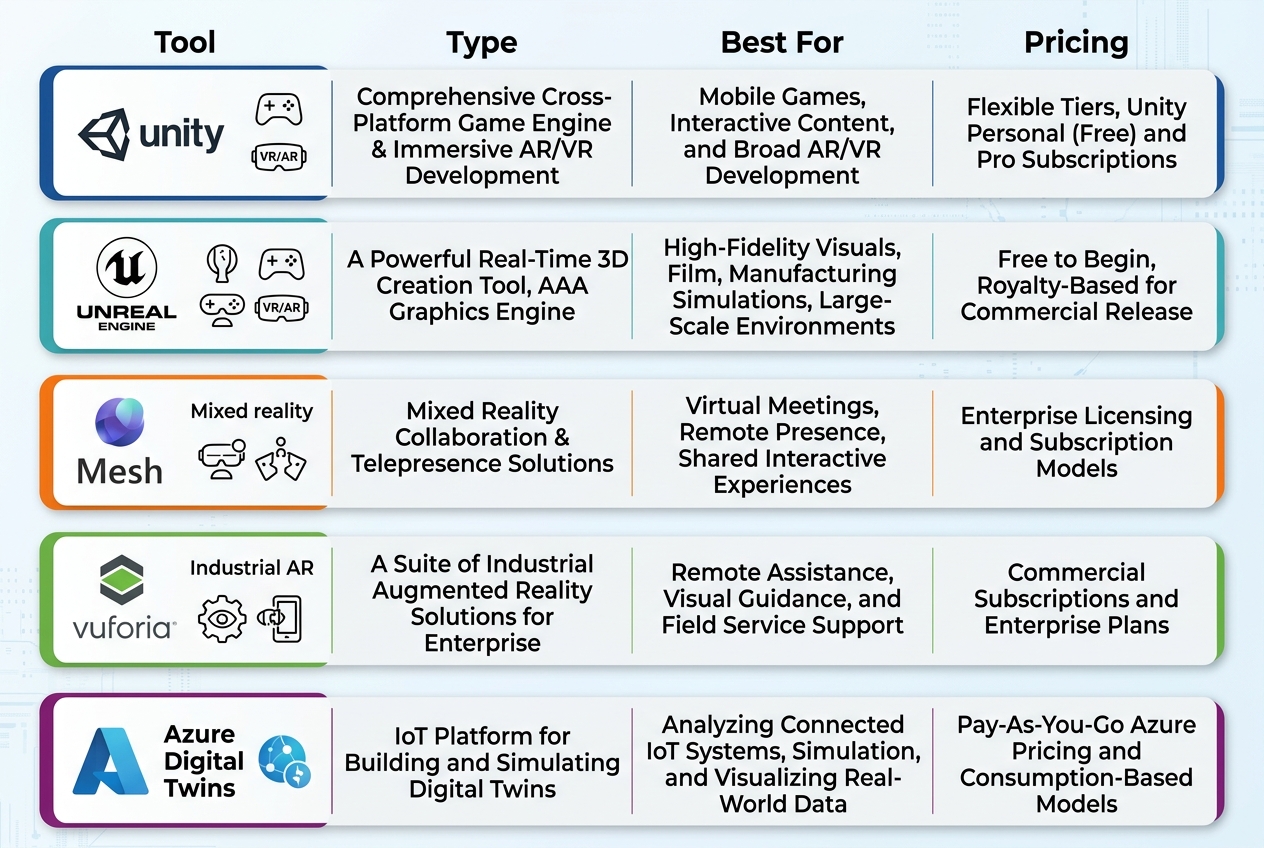
Comparison of leading immersive technology platforms for enterprise metaverse solutions.
For Australian businesses looking to establish a metaverse presence, partnering with local expertise can help navigate the evolving landscape of immersive platforms. As you evaluate these options, Metaverse Development Australia can align your needs with the right technology stack and ensure your immersive strategy delivers measurable results. By focusing on your organisational objectives, you can identify which immersive platform will drive the most value for your digital transformation initiatives.
Next Steps for Your Enterprise Immersive Strategy
Now that you have explored how immersive technology solutions can create more connected, engaging, and efficient operations--from virtual showrooms to real-time training environments--it's time to map out a strategic path forward. A successful enterprise immersive strategy begins with a clear assessment of your organisation's current digital maturity and the specific pain points that immersive tech can address.
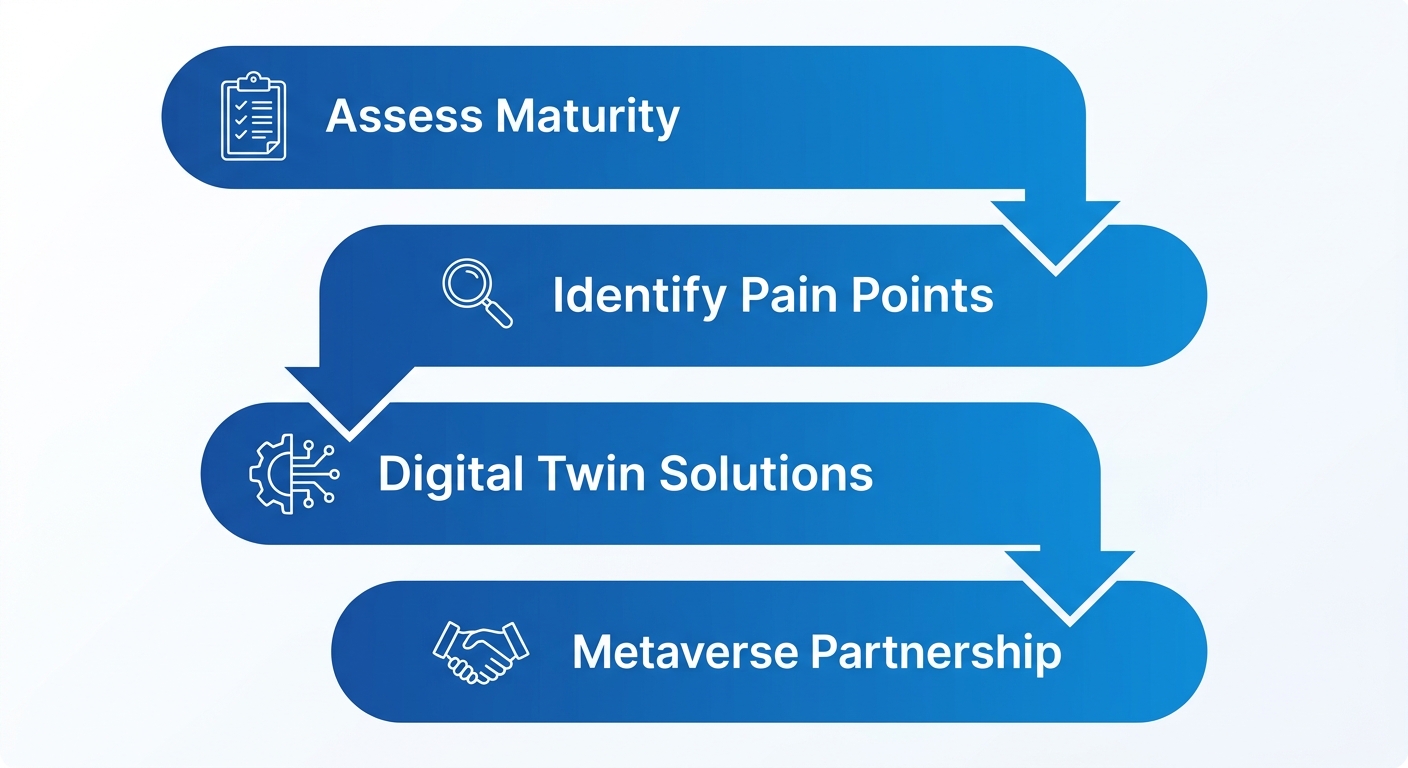
Four-step process for implementing enterprise immersive strategy.
The following steps outline a practical framework for activating immersive innovation:
- Evaluate your digital maturity to identify gaps and opportunities.
- Pinpoint operational pain points that industrial AR solutions can solve.
- Prototype digital twin integration to gain real-time visibility of assets or processes.
- Partner with experienced metaverse developer services to design and deploy your custom solution.
Whether you start with industrial AR solutions to assist field workers or implement digital twin integration to simulate complex systems, each step builds on the previous one. The right blend can unlock measurable gains in productivity, safety, and customer experience. To turn your vision into reality, reach out to our team of metaverse developer services for a personalised consultation -- we'll help you design a strategy scaled to your goals, whether you operate in Australia or across international markets.