Metaverse app development relies on foundational technologies that enable immersive real-time experiences. At its core, spatial computing architecture processes three-dimensional data and user interactions to create responsive virtual environments. Equally important are interoperable 3D environments, which allow digital assets and identities to move seamlessly across different platforms. The World Wide Web Consortium (W3C) advances open Web3D standards such as glTF and X3D, ensuring that content remains accessible and consistent regardless of the device or engine powering the experience.
Enterprises are leveraging these technologies to build immersive training simulations, conduct virtual product demonstrations, and create remote collaboration spaces that connect distributed teams. Organisations partnering with experts in metaverse development services can accelerate their entry into these environments while adhering to established best practices. The XR Association provides industry guidelines covering safety, privacy, and accessibility, helping developers create responsible metaverse applications that protect user trust.
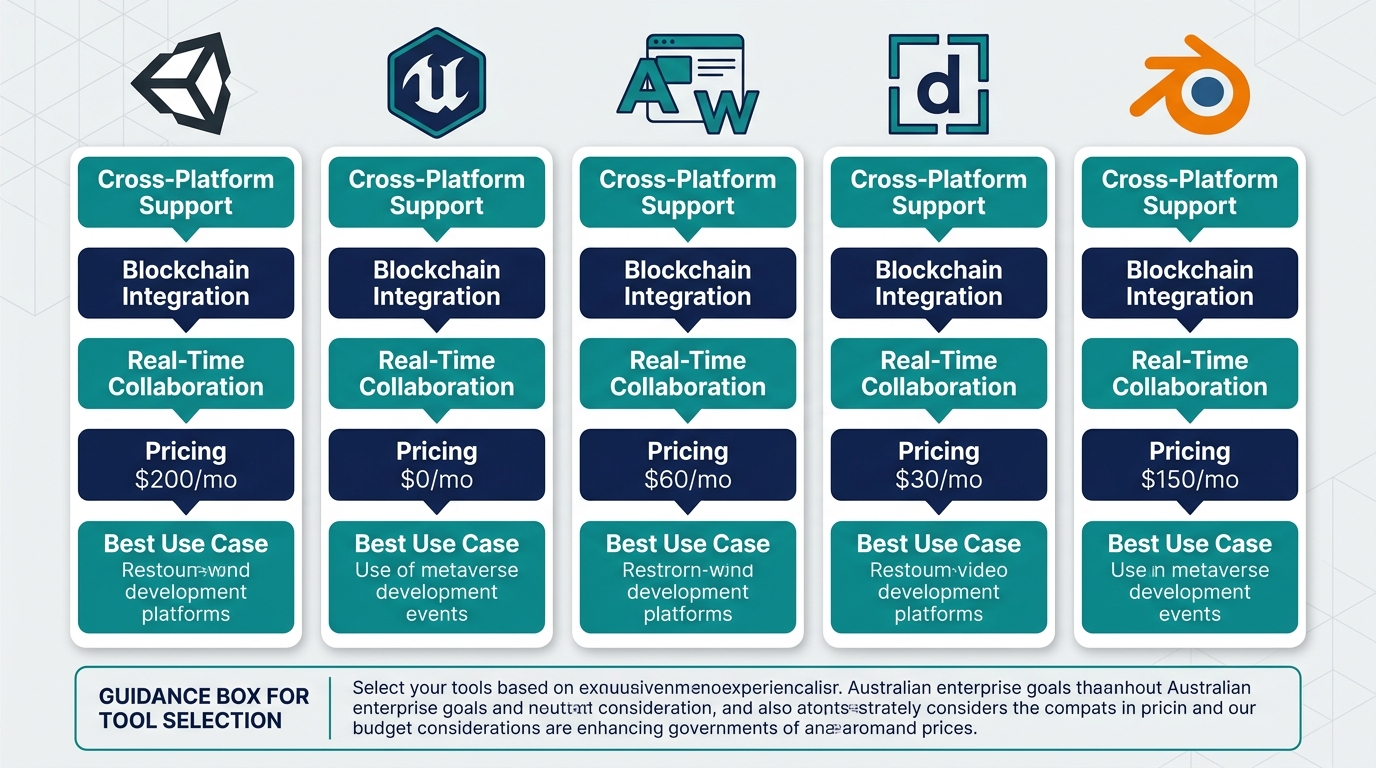
Metaverse development platform comparison for Australian enterprise teams.
Technology progression from spatial computing to enterprise metaverse applications.
The following section walks through the metaverse application development process in detail, examining each stage from initial concept through deployment in the Australian and international markets.
Unity is a leading real-time 3D engine for metaverse app development, providing cross-platform deployment across mobile, desktop, AR/VR headsets, and web. Its extensive Asset Store accelerates content creation.
Core features include high-fidelity real-time rendering optimised for spatial computing architecture, AR Foundation for augmented reality, Unity Multiplayer Networking for shared experiences, and the XR Interaction Toolkit for VR and gesture input. These capabilities align with XR Association industry guidelines for user safety.
Unity offers Personal (free for qualifying individuals), Pro (per-seat subscription), and Enterprise (custom) tiers, scaling for commercial metaverse projects.
Strengths include a large community, extensive tools, and support for interoperable 3d environments. Drawbacks include a steep learning curve for advanced networking and ongoing subscription costs for Pro/Enterprise users.
Ideal for enterprises building cross-platform metaverse experiences requiring high interactivity, real-time collaboration, and rapid prototyping.
Unreal Engine is prized for its high-fidelity visuals and MetaHuman avatars, driving metaverse app development. Its expanding role in Web3 and metaverse development supports the creation of immersive worlds.
Unreal Engine's Nanite virtualised geometry and Lumen dynamic lighting drive spatial computing architecture with unparalleled realism. Pixel Streaming brings experiences to web browsers, and OpenXR provides interoperable 3D environments for various XR hardware.
Revenue above USD 1 million per title per quarter incurs a 5% royalty. Custom enterprise licencing is available.
Unreal Engine delivers film-grade visuals, excellent scalability for large worlds, and robust VR creation tools. On the downside, its learning curve is steep and hardware needs are substantial.
Best suited for architectural visualisation, virtual events, film-grade experiences, and immersive storytelling projects where premium visual fidelity is paramount.
WebXR is the W3C API that brings VR and AR experiences straight to the browser, removing the friction of app-store downloads and making metaverse app development accessible to anyone with a web link.
A-Frame is fully open-source under the MIT license, meaning zero licensing fees for startups, educators and enterprise teams.
Rapid prototyping, educational tools and lightweight metaverse experiences where accessibility is prioritised over graphical fidelity.
For metaverse app development, Decentraland provides a decentralised virtual world on Ethereum. Its SDK lets developers create interactive scenes, social experiences, and monetisable land parcels.
The TypeScript SDK is grounded in spatial computing architecture for interactive 3D scenes. LAND is an NFT securing virtual land ownership, and MANA acts as the internal currency. VRM avatars enable social presence with interoperable 3d environments, connecting blockchain assets.
Development is free on owned LAND; costs include LAND purchase or rental and blockchain gas fees. MANA tokens handle payments.
Advantages include native blockchain integration, a user-owned economy, and an active developer community. Limitations involve high LAND cost barriers, scene complexity constrained by browser performance, and variable Ethereum gas fees.
Ideal for brands establishing a permanent virtual presence, hosting events, and selling digital assets in a decentralised marketplace.
Blender is a free, open-source 3D creation suite essential for metaverse app development. This tool provides the modelling, rigging, and animation capabilities needed to build assets for interoperable 3d environments that rely on open standards.
The full pipeline includes modelling, sculpting, texturing, armature rigging, physics simulation, and real-time viewport rendering. For broad platform compatibility, Blender exports to glTF, FBX, OBJ, and COLLADA. According to the Web3D Consortium, standardised web formats like glTF are essential for spatial computing architecture and cross-platform 3D content delivery.
Blender operates under the GNU General Public License (GPL). It is free software with no licensing costs or royalties, making it accessible for any budget.
Pros:
Cons:
Blender excels at creating custom geometry and animation for developers who need portable assets across multiple metaverse platforms, ensuring true 3D environment interoperability.
Evaluating platforms for metaverse app development requires comparing cross-platform support, blockchain, and collaboration features.
The comparison reveals distinctive strengths: Unity's cross-platform support makes it versatile, while Unreal Engine excels in high-fidelity rendering with spatial computing architecture. WebXR/A-Frame delivers interoperable 3D environments on the open web, a model aligned with World Wide Web Consortium (W3C) standards. Decentraland SDK's native Ethereum integration suits tokenised experiences, and Blender provides a free content-creation pipeline. For Australian teams, local Unity and Unreal communities offer practical support.
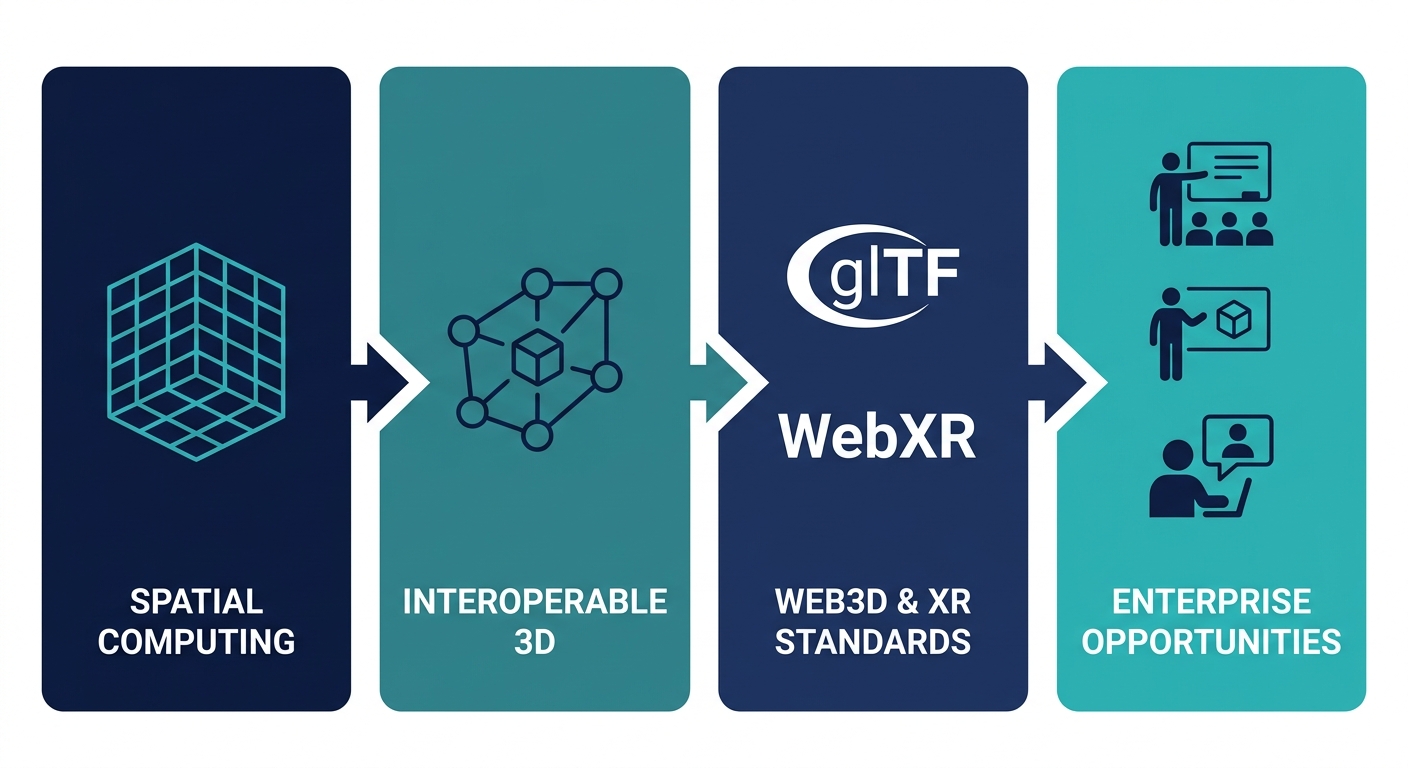
Technology progression from spatial computing to enterprise metaverse applications.
Metaverse development platform comparison for Australian enterprise teams.
When selecting a tool, align platform strengths with project goals. Unity is well-suited for cross-platform virtual world development thanks to its extensive device support and robust real-time collaboration via Photon or Netcode. Unreal Engine shines for cinematic-quality experiences, and WebXR/A-Frame excels for browser-based education or events without app-store friction. Decentraland SDK is the go-to for tokenised virtual land and branded events, leveraging native Ethereum integration. For many enterprises, combining Unity for interactive worlds, Unreal for high-fidelity visuals, and Blender for custom assets creates a resilient stack for metaverse app development. Following XR Association (XRA) guidelines helps maintain user privacy and responsible design, a critical consideration for Australian organisations. Always pilot test shortlisted platforms against actual project requirements before full commitment.
When starting a metaverse app development project, selecting the right tools is crucial. Your choices shape user experience, scalability, and long-term success. Following established web standards helps keep your creation accessible. The World Wide Web Consortium (W3C) provides guidance for building interoperable 3d environments that work across browsers and devices. Open standards like WebXR reduce vendor lock-in and support VR, AR, and desktop.
Key criteria for tool evaluation include:
Your project's requirements--whether building a Web3 gallery or a complex spatial computing architecture--guide tool selection. Prioritizing open standards supports long-term maintainability and flexibility. A thoughtful choice underpins successful metaverse app development. Next, we'll explore development methodologies to bring your vision to life and practical planning for successful delivery.
