
Table of Contents
Exploring Metaverse Game Development: A Strategic Guide for Enterprises
For enterprises seeking to boost brand engagement and generate new revenue streams, metaverse game development offers strategic opportunities. As highlighted by Google Cloud's enterprise deployment strategies, interoperability is crucial to avoid vendor lock-in - aligning with Web3 asset interoperability principles that enable seamless experiences across virtual worlds. This strategic alignment positions enterprises to capitalise on emerging digital economies.
Successful deployment requires careful platform selection, scalable infrastructure, and a content strategy aligned with overall business goals. Integrating spatial computing architecture enhances real-time interaction and immersion but demands robust backend support. Enterprises must also evaluate how Web3 asset interoperability facilitates user-generated content and digital economies.
Risk mitigation involves establishing clear performance indicators and phased investments to balance innovation with fiscal responsibility. With strategic planning, organisations can measure return on investment while building future growth in virtual engagement channels. To explore tailored enterprise metaverse solutions for your business and learn about technical implementation details, continue reading.
Foundational Requirements for Metaverse Game Development
As interest in virtual worlds accelerates, metaverse game development demands more than just creative design -- it requires a robust technical backbone. According to Google Cloud, cloud infrastructure is fundamental for achieving the scalability needed to support massive, real-time multiplayer interactions without degrading performance.
Spatial computing architecture is what transforms a digital space into an immersive 3D environment where you can interact naturally. This includes advanced spatial mapping and environment persistence. Furthermore, Web3 asset interoperability introduces genuine digital ownership, allowing players to seamlessly transfer their in-game assets across platforms. To bring these complex systems together, many organisations choose to partner with a metaverse development company that can architect the complete solution. These systems must be designed for extensibility and efficient content streaming across regions.
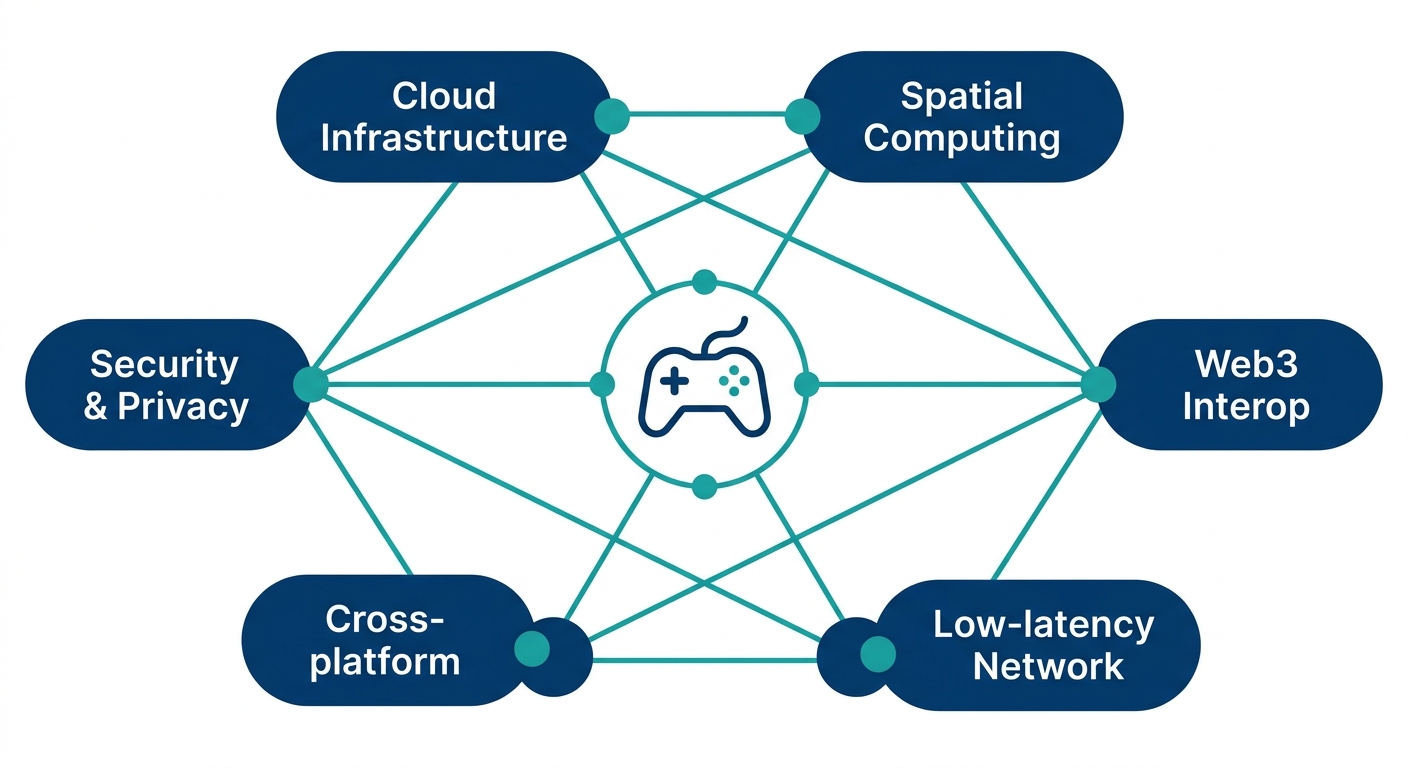
Six interconnected foundational requirements for metaverse game development.
Low-latency networking combined with edge computing ensures the responsive, lag-free experiences players expect. You also need a strategy for cross-platform compatibility from the start to reach users on any device. Robust monitoring and update mechanisms help maintain stability as user concurrency scales globally. Finally, integrating rigorous security and data privacy measures protects both the user and the integrity of the virtual economy.
Define Your Metaverse Game Concept and Scope
The metaverse game development landscape is expansive, but now you must crystallise your own concept. Begin by clarifying your game's genre, whether social, adventure, or simulation, and its unique selling points. Define the player experience you want to deliver and identify your target audience's motivations for engaging in a metaverse environment. A globally minded audience may seek social connection, ownership, or immersive exploration.
Next, scope your first release by outlining core features and supported platforms (PC, VR, mobile) with a realistic MVP timeline. This focused scope will guide later technology choices. Prioritise iterative development and community feedback over guarantees of massive user numbers or revenue.
When shaping your concept, embed Web3 asset interoperability from the start, planning for cross-game NFTs and player-owned wallets to enhance engagement. Consider how spatial computing architecture influences 3D space, physics, and real-time interactions. These foundational decisions set the stage for the technical architecture explored in the next section.
Select the Core Technology Stack and Platform
Choosing the right technology is the decisive step in metaverse game development, moving you from concept to tangible build. Your first major decision involves selecting a game engine. Many developers find Unreal Engine suitable for projects requiring high-end visual fidelity, while Unity offers strong support for rapid prototyping and broad platform deployment when building metaverse games.
Next, your cloud platform must support low-latency, real-time interactions and multi-region deployment. According to Google Cloud's infrastructure guidance, key considerations include scalability to handle concurrent users and a content delivery strategy that minimizes lag for a global audience, including Australian players where data residency may be a factor. Your underlying spatial computing architecture defines how all these services connect.
Finally, assess blockchain networks that prioritize Web3 asset interoperability, allowing players to own and trade items across different virtual experiences. The platform you choose--whether Steam, the Oculus Store, or a custom launcher--will directly shape your audience reach and deployment complexity. With these core decisions made, your team is ready to begin the hands-on development and testing phase.
Design the 3D Virtual World and User Experience
In metaverse game development, crafting an immersive 3D virtual world begins with a strong spatial computing architecture. This architecture organises the environment's spatial layout, defines interaction zones, and optimises real-time rendering. As Google Cloud's spatial computing best practices suggest, thoughtful scene structuring reduces cognitive load while enhancing physical navigation. You should map out movement paths, interactive objects, and social hubs early, so the world feels intuitive rather than overwhelming.
User interactions and navigation must follow those same spatial computing principles. Smooth teleportation, gaze-based selection, and spatial audio cues keep the experience accessible. Here, Web3 asset interoperability becomes a design advantage -- when in-world items like avatars or virtual land are tokenised, you can design persistent economies where players truly own and trade assets across experiences. This shapes the layout of marketplaces, galleries, and public spaces, encouraging community engagement without sacrificing performance.
Scalability underpins every decision. As your metaverse game development project grows, load-balancing across server instances and managing asset streaming ensures consistent framerates. By anchoring your design in user-centric, interoperable spaces, you create a virtual world that feels alive and ready for the technical implementation that follows.
Implement Blockchain Integration and Digital Ownership
Building on current trends in metaverse game development, integrating blockchain technology is fundamental to enabling true digital ownership. This approach allows you to use non-fungible tokens (NFTs) to represent unique in-game assets, granting players verifiable control and security over their virtual items. The Web3 asset interoperability standards, as outlined by Google Cloud, provide a crucial framework for ensuring these assets can move freely across different platforms and experiences.
Adopting these digital token standards helps you create more persistent and player-driven economies within your spatial computing architecture. This integration enhances security and user autonomy, allowing players to truly own what they earn or create without relying on a single game server. By focusing on interoperability, you can design metaverse game development projects where assets maintain their value and identity across an entire ecosystem, paving the way for more complex virtual worlds.
Build for Web3 Asset Interoperability
As metaverse game development expands across platforms, Web3 asset interoperability becomes essential for allowing your digital items, tokens, and NFTs to move freely between different blockchains and virtual worlds. This seamless portability enhances user experience, increases asset liquidity, and unlocks composable in-game economies where items retain value beyond their original environment. According to industry guidance on interoperability standards, emerging protocols such as cross-chain bridges and the multi-token ERC-1155 specification, together with W3C web standards, are establishing the common frameworks needed for true cross-platform asset transfer.
By building for interoperable assets, you reduce vendor lock-in and give players genuine ownership that travels with them across metaverse experiences. A well-designed spatial computing architecture supports this interoperability by providing a unified data layer that bridges physical and virtual worlds, allowing your metaverse project to organise and render assets consistently regardless of the underlying chain or platform.
Develop the Spatial Computing Architecture and Backend
Spatial computing architecture forms the digital backbone of any metaverse game development project, enabling immersive, context-aware experiences that blend physical and virtual realities. Translating a game concept into a functional persistent world requires a carefully structured framework of sensors, spatial mapping engines, and real-time rendering pipelines that process environmental data with minimal latency.
Building this foundation in Australian metaverse projects demands a backend infrastructure designed for cloud scalability and distributed computing. According to industry best practices for spatial computing architecture, sensor fusion and real-time spatial mapping must work in concert to maintain seamless player interactions. Furthermore, cloud infrastructure research for metaverse games emphasizes the critical role of edge computing nodes in reducing latency for geographically dispersed users.
Achieving true Web3 asset interoperability within this architecture hinges on integrating blockchain protocols that allow digital assets to move freely across virtual environments. These backend design choices, informed by both spatial computing frameworks and cloud infrastructure guidelines, directly connect the architectural blueprint to the subsequent implementation and testing phases.
Test, Deploy, and Iterate with Real-Time Feedback
Building on the design and development phases, testing becomes the critical bridge to live operation in metaverse game development. Real-time validation checks game logic. It also confirms Web3 asset interoperability across platforms.
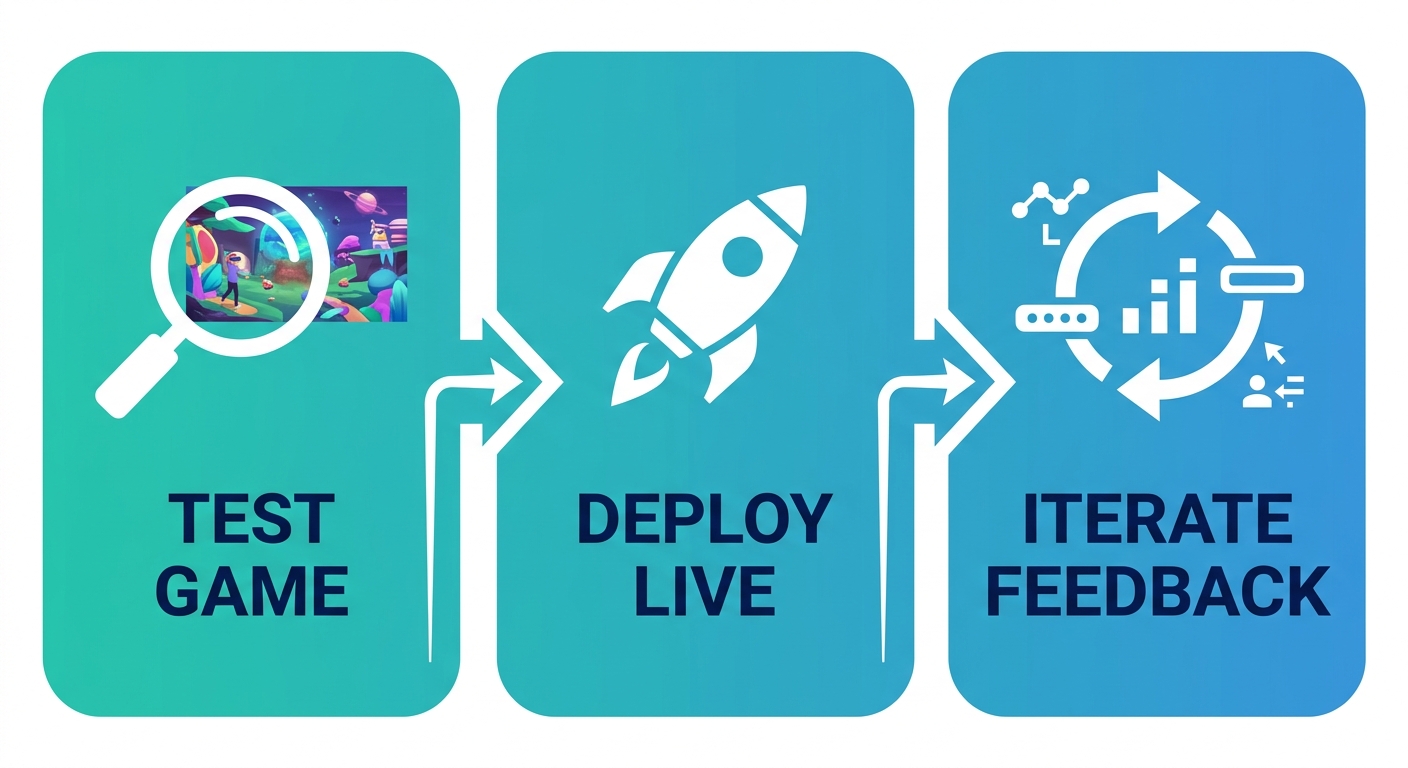
Three-step test-deploy-iterate process for metaverse game development.
When you're ready to deploy, you follow a phased pipeline. Start with smart-contract audits, then load-test on decentralized infrastructure. Deploy to a testnet before mainnet to reduce risks. This process must handle the demands of a spatial computing architecture, where real-world physics and gesture recognition respond instantly.
Use real-time feedback to iterate. Adjust gesture-recognition thresholds from analytics, and refine asset-bridging from on-chain event logs. You can collect feedback from these sources:
- Bug reports and session replay tools
- On-chain event logs
- Community polls and in-session surveys
- Heatmap analytics from spatial interactions
Each iteration respects user data privacy and platform governance rules, balancing improvement with responsible data handling. This test-deploy-iterate loop feeds directly into the next phase, Maintain and Scale Your Metaverse Game, where you manage growth and performance.
Overcoming Common Metaverse Game Development Challenges
Building on the foundational concepts of metaverse game development, you will inevitably encounter a unique set of technical and organizational hurdles. These challenges range from ensuring your virtual world can handle massive concurrent user bases to creating seamless economies that cross platform boundaries. Understanding these obstacles early is the first step to architecting a robust digital universe.
Scalability is often the primary concern for developers. Persistent virtual worlds demand an architecture that dynamically responds to fluctuating player populations without degrading performance. Drawing on enterprise deployment strategies, Google Cloud notes that a distributed, microservices-based backend is crucial for overcoming this. Techniques like global load balancing and edge computing ensure low-latency interactions for users, regardless of their physical location, making real-time rendering at scale a solvable problem rather than a hard limit.
Another critical enabler is Web3 asset interoperability, which solves the problem of economic isolation in proprietary walled gardens. By designing your metaverse game creation around open standards, the interoperable assets your players earn or purchase can function across different virtual experiences. This cross-platform utility significantly enhances user retention and perceived value, transforming a single game into a node within a larger, user-owned digital economy.
Finally, an intuitive user experience hinges on a solid spatial computing architecture. You need to build interfaces for natural, immersive interactions that go beyond a flat screen. Effective spatial design helps you overcome the navigation hurdles inherent in 3D spaces, making your metaverse feel responsive and real. These challenges are addressed through iterative design and cross-team collaboration, paving the way for the deeper technical implementations discussed next.
Bringing Your Metaverse Game Vision to Life
Every successful metaverse game development project begins with a discovery workshop, where we align your creative vision with technical feasibility. This collaborative session explores your target audience, core gameplay mechanics, and desired immersive experiences to create a tailored roadmap for your project.
From there, our iterative development cycle keeps you involved at every stage. Regular feedback points allow you to refine game mechanics and visual elements as the experience takes shape. Our broader expertise in virtual world development, serving clients across Australia and internationally, means we incorporate proven enterprise deployment strategies -- including phased rollouts -- to ensure your game scales reliably. Modern metaverse games rely on Web3 asset interoperability and spatial computing architecture to deliver persistent, interconnected experiences that users can trust.
Our team manages the entire lifecycle, from initial concept design through launch and beyond. With ongoing post-launch support, your game project remains adaptable as player expectations evolve -- a topic the next section explores through the specific technologies powering today's most engaging virtual worlds.